Method
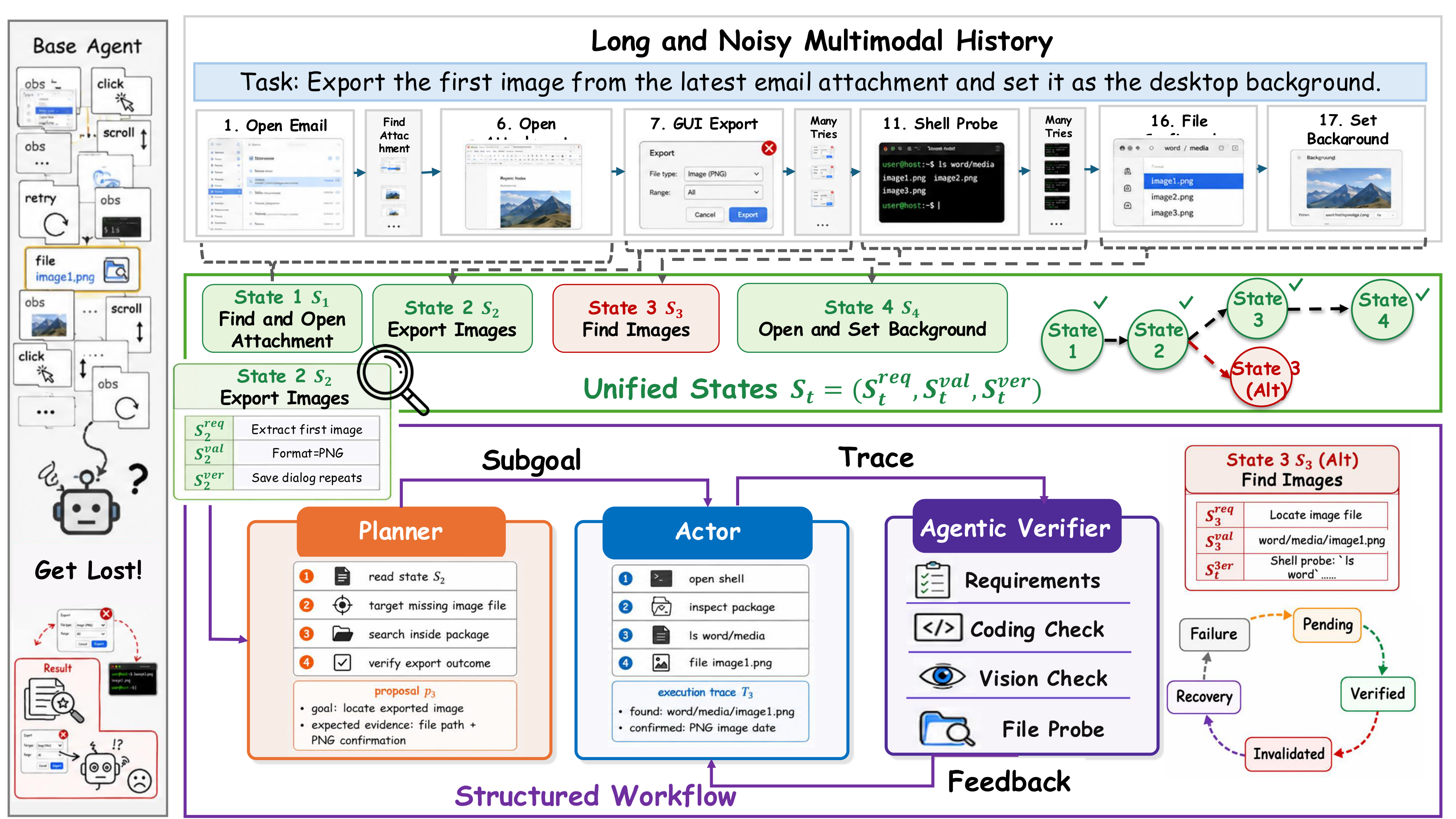
Planner · Actor · Verifier over a shared State
The verifier is the only writer of progress. Everything else reads and proposes.
arXiv:2607.11388 · 2026
Progress you can verify — not just claim.
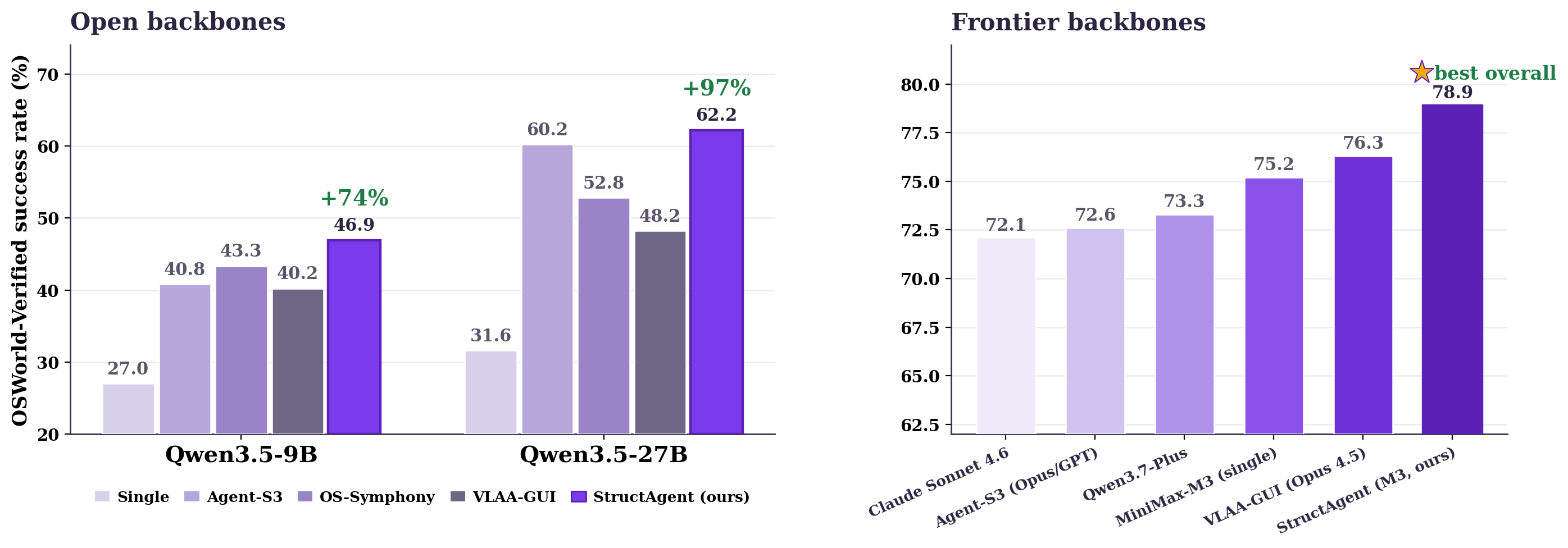
Recent advances in large language models (LLMs) and vision-language models (VLMs) have enabled increasingly capable digital agents for computer use. However, real-world tasks are often long-horizon and involve evolving contexts containing accumulated observations, intermediate edits, failed attempts, and partially completed executions. Existing agents typically operate over raw interaction history, making task progress difficult to interpret, verify, and recover, which ultimately limits reliable long-horizon execution. In this paper, we argue that addressing this challenge requires explicitly structuring both the agent's state and workflow around a unified causal representation of task progress. We present StructAgent, a state-centered framework that introduces a unified state for maintaining compact, verifiable task progress and a structured workflow that regulates progress through verifier-backed state transitions. Building on this design, StructAgent further enables explicit progress checkpointing, evidence-driven task completion, targeted failure recovery, and tool-supported execution, while ensuring that all progress updates remain grounded in verification. Extensive experiments demonstrate that StructAgent consistently improves a wide range of LLM and VLM backbones on long-horizon computer-use tasks. On OSWorld-Verified, it improves Qwen3.5-9B from 27.0% to 46.9% success rate and Qwen3.5-27B from 31.6% to 62.2%, while achieving a new open-source state of the art of 78.9% with MiniMax-M3. Moreover, the same framework generalizes beyond desktop environments to Minecraft, demonstrating the generality of our design.
The verifier is the only writer of progress. Everything else reads and proposes.
On OSWorld-Verified, StructAgent raises open Qwen3.5 backbones by +74% (9B) and +97% (27B) in relative success over the single-model agent, beating every open-source agent framework at matched settings. With the MiniMax-M3 backbone it reaches 78.9% — the best overall, above frontier single models and their agent frameworks.
Three OSWorld cases, side by side: a single-model baseline (no verifier) versus StructAgent's planner–actor–verifier. Step through each to see the ledger seal outcomes with evidence — and the baseline fabricate its way to a wrong answer.
StructAgent mines reusable skills from its own solved trajectories. Each skill records when to use it, a step-by-step plan template, and the pitfalls seen in practice — then feeds the planner on new tasks.
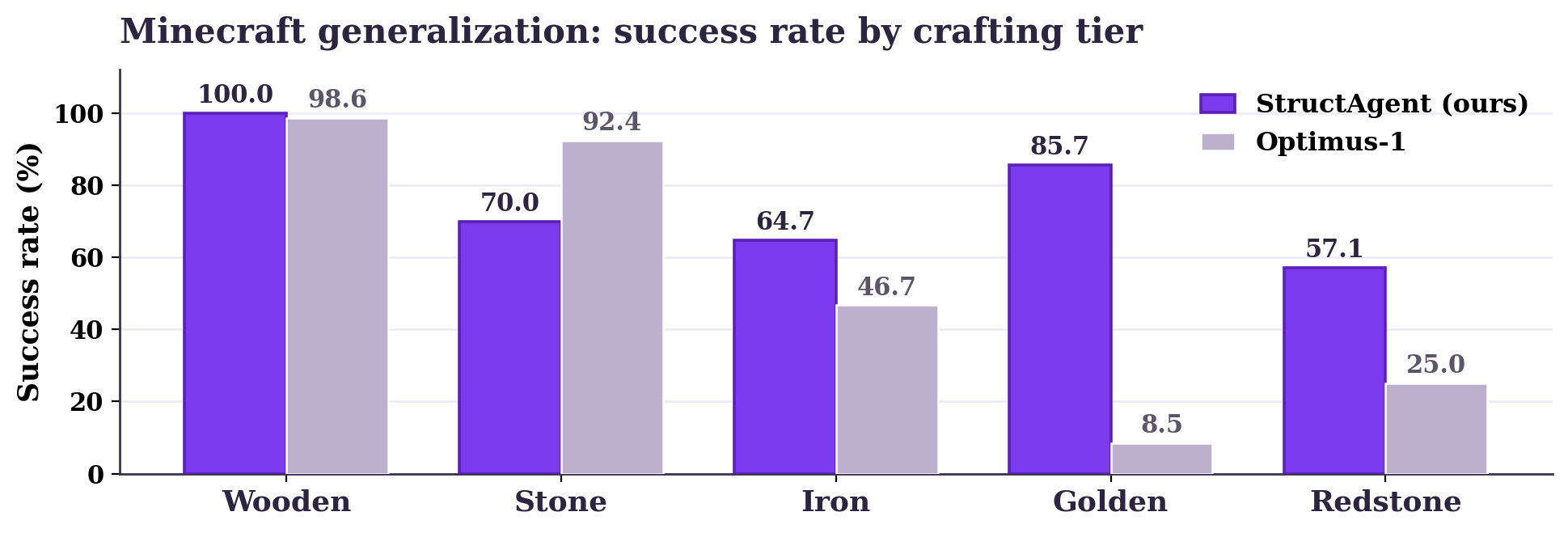
The same verifier-derived State and role separation transfer to Minecraft — milestones become
(verb, item, n) and the verifier reads inventory-delta probes instead of accessibility or
file probes. StructAgent plays through multi-step crafting the same way it drives a desktop.
Clips sped up for viewing. Full success-rate breakdown across five crafting tiers is in the results above.
Explore the StructAgent-Minecraft repo →Both backbones were run over all 360 OSWorld-Verified tasks — every solved run replays here, step by step. Per-step screenshots, verifier events, the plan, and the full debug trace are released. Search and filter the complete index below (click any ✓ run to replay it); the full-resolution viewers are on Hugging Face.
A walkthrough of Aether AI's overall architecture and vision, with an overview of our current projects.